A little entertainment for your Friday night – Enjoy!
Have Fun! – Run the Gun! – and remember – Fish Heads are Cheap!!
A little entertainment for your Friday night – Enjoy!
Have Fun! – Run the Gun! – and remember – Fish Heads are Cheap!!
The ultimate goal has always been to be able to master “Time” – Seriously folks – we are all time travelers – but – it’s a one-way trip . . .
So, does reality end where the dream begins? Or does the reality and the dream overlap? Or is time travel (from our collective programming) impossible simply because we “know” it’s impossible?
45 years ago . . .
seems like yesterday doesn’t it??
Kinda sorta like any Friday Music with GFRR – I must do “We’re An American Band” – well I just can’t do any “Floyd” without dropping this in the mix . . .
this comfortably numb society we exist in – is that a feature or a bug? or by design??
Blinders on and stagger through your Friday – then enjoy your weekend!
Have Fun! – Run the Gun! – and remember – Fish Heads are Cheap!!
a little postscript . . .
2 moves in less than a year to get settled into retirement – going through some boxes full of shit and found one of my retirement gifts that I thought was gone forever . . .
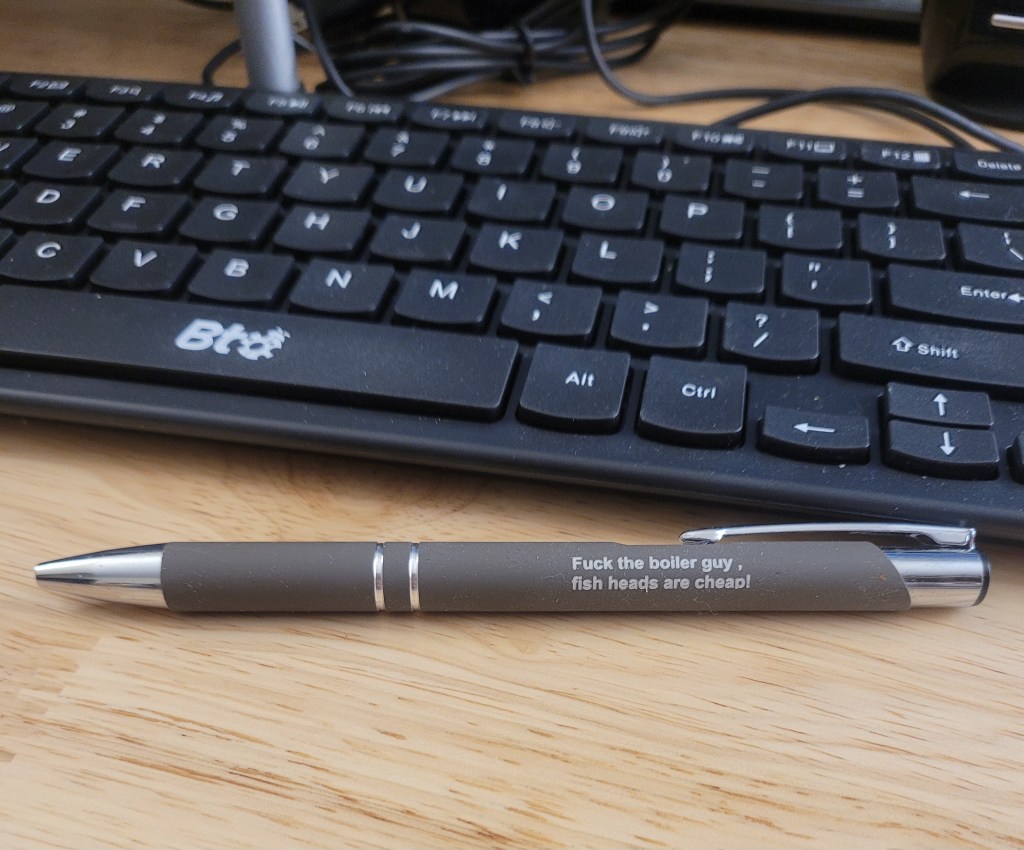
Got a package from Sarco Inc. today – Thursday – which is pretty good since I ordered these on Monday – way to go Sarco!
Now I can start burning the new to me 01911C Colt Government Model into muscle memory.
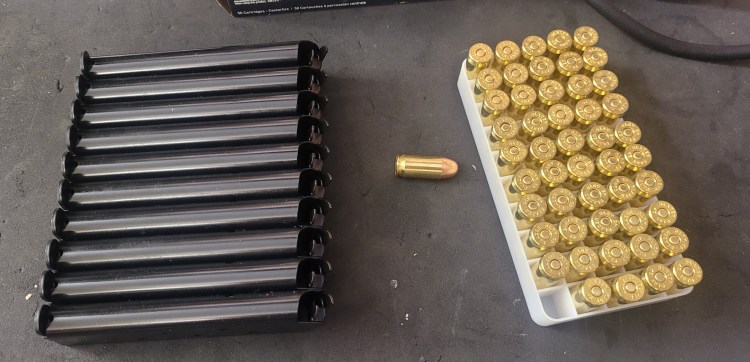
I bought 3 of these awhile back and they run good – and I really like to go and do the shooting thing – the reloading magazine think? – not so much . . .
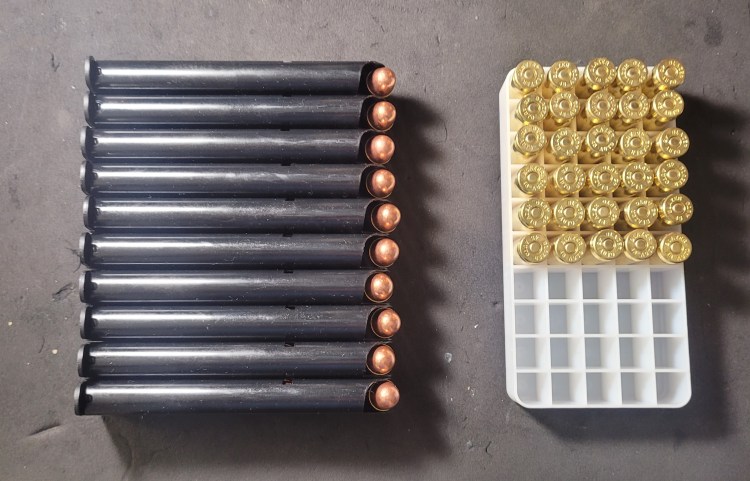
I can really enjoy getting into the rhythm of shooting and then you have to stop and load mags – or dig out my loaded mags and take them along as well. and that’s a pain since they are all sleeping soundly with their respective 1911s in the boxes. This way I can really focus on the shooting – run 70 rounds – then step back and throw everything in the range bag and beat feet home.
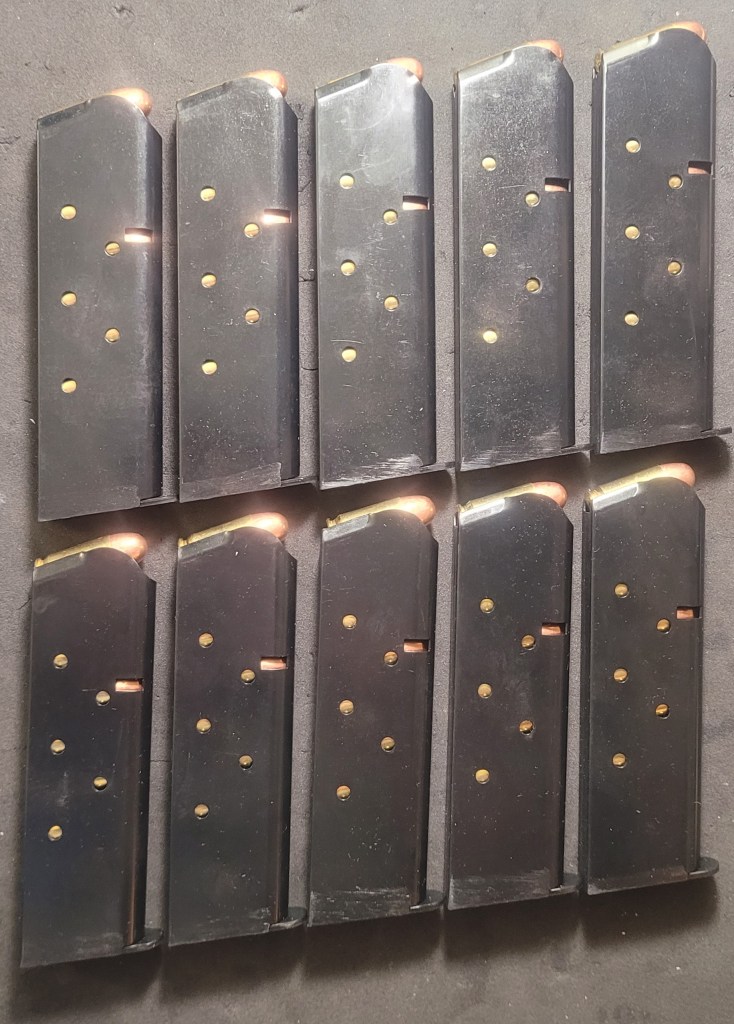
Ain’t they purty – LOL!
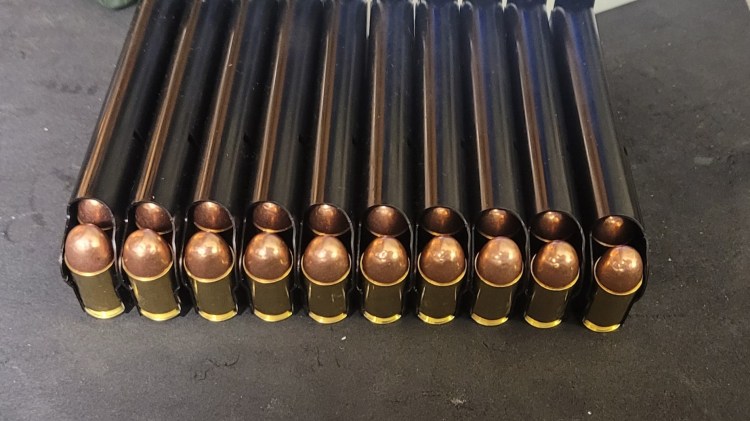
Get home and wipe the mags down – reload and into the range bag they go. Then bath time for the pistol – or if I shoot more than 1 – pistols – and ready for the next trip. 70 rounds lets me get into the zone to the point that when the trigger breaks I pretty much know where the shot is going to land. It took 3 to 5 hundred rounds each for my EDC Rock Island and the Colt M1991A1 to get to that point – I run 1 or 2 magazines in either one before I rotate it into carry – that’s about all it takes to get the “feel” for it once I burn one into muscle memory.
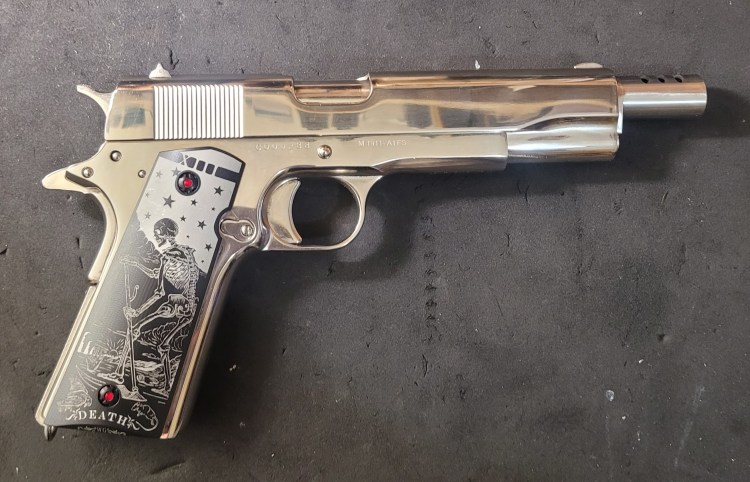
My BBQ / Sunday Go To Meeting 1911 I shoot 3 or 4 times a year . . .
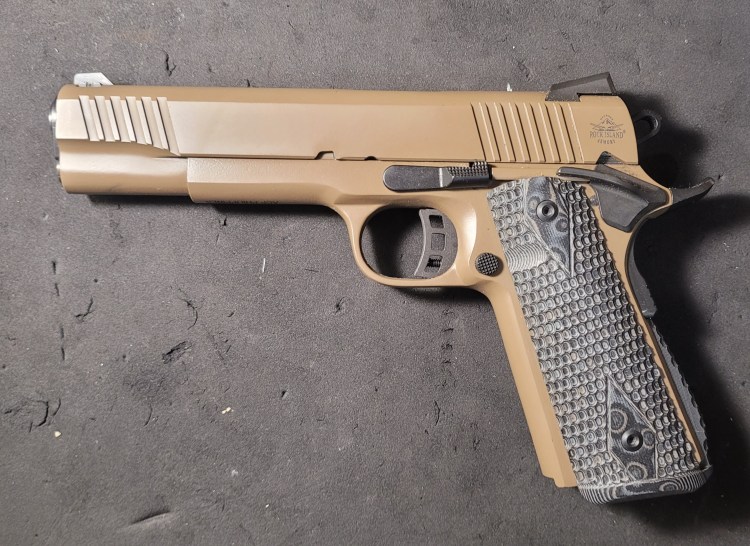
The newest RIA in the house – just ran 4 or 5 mags through it for a function check – once I get the “new” Colt dialed in I will start in on it . . .
It so much wants to be my primary RIA carry – patience young Jedi – patience! – LOL!
Remember folks – get out and practice – a 2 way range is NOT where you want to realize you should have practiced a wee bit more! With winter upon most of us, I would like to remind you – indoor ranges are warm and not covered in snow.
Have Fun! – Run the Gun! – and remember – Fish Heads are Cheap!!
And another Michael Caine “vehicle” for your Saturday night enjoyment!
Have Fun! – Run the Gun! – and remember – Fish Heads are Cheap!!
It was different actually shooting with the new lenses in my eyes – and it goes back to several things I have said again and again. Practice / Practice / Practice
the 80X fresh out of the bath – ready to go back in its “spot” in the house
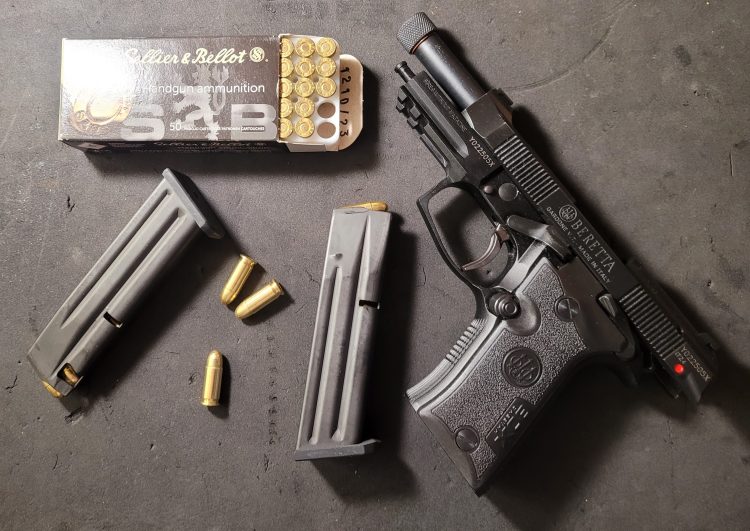
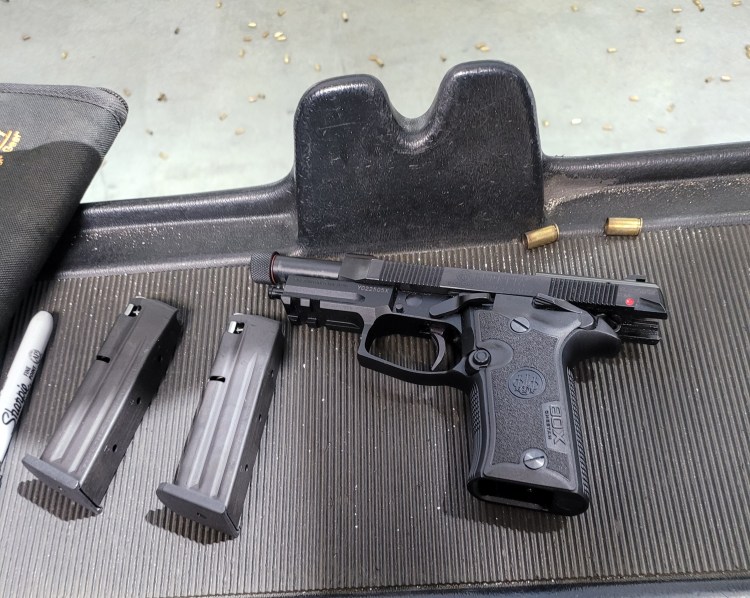
I have shot the 80X multiple times – with both the 380 barrel and the .32acp barrel from Allegheny Arms – the little darling just shoots well as a 380 – and it is “Oh So Sweet” shooting it with the .32acp barrel . . .
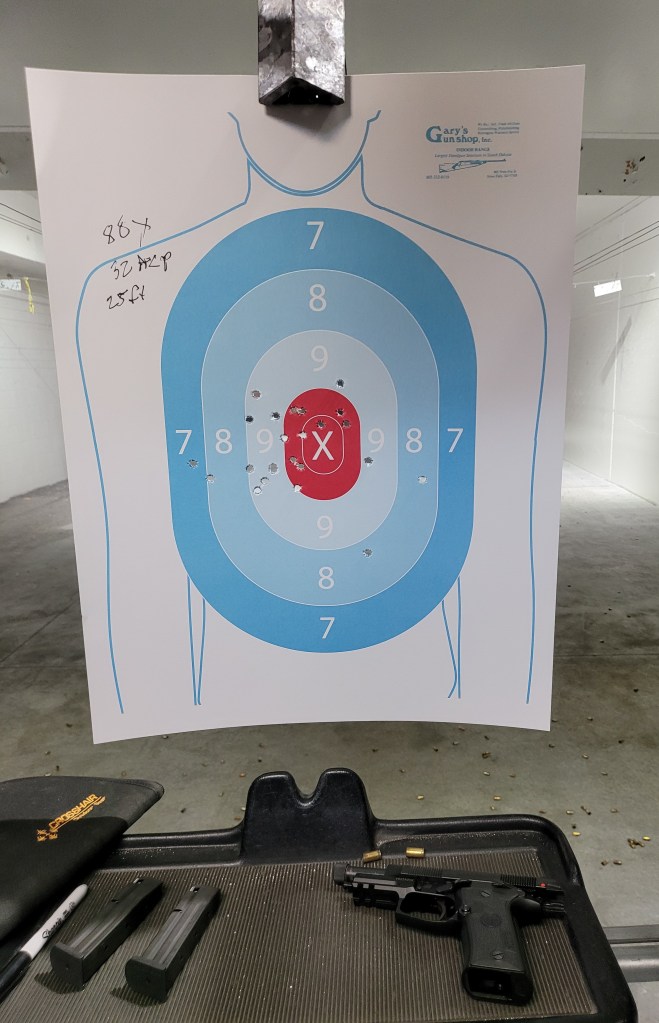
Having previously shot it I was pretty much dialed in as far as grip – sight picture – the only difference was more “target” information – a crisper picture is how I would describe it – and did I mention it was an absolute joy to shoot in .32acp?
Swapped out the Colt M1991A1 out of carry rotation with my RIA and brought the M1991A1 to the range just to dial it in – with the new eyeballs . . .
yep – that works – different but it works . . .
2 mags dumped . . .
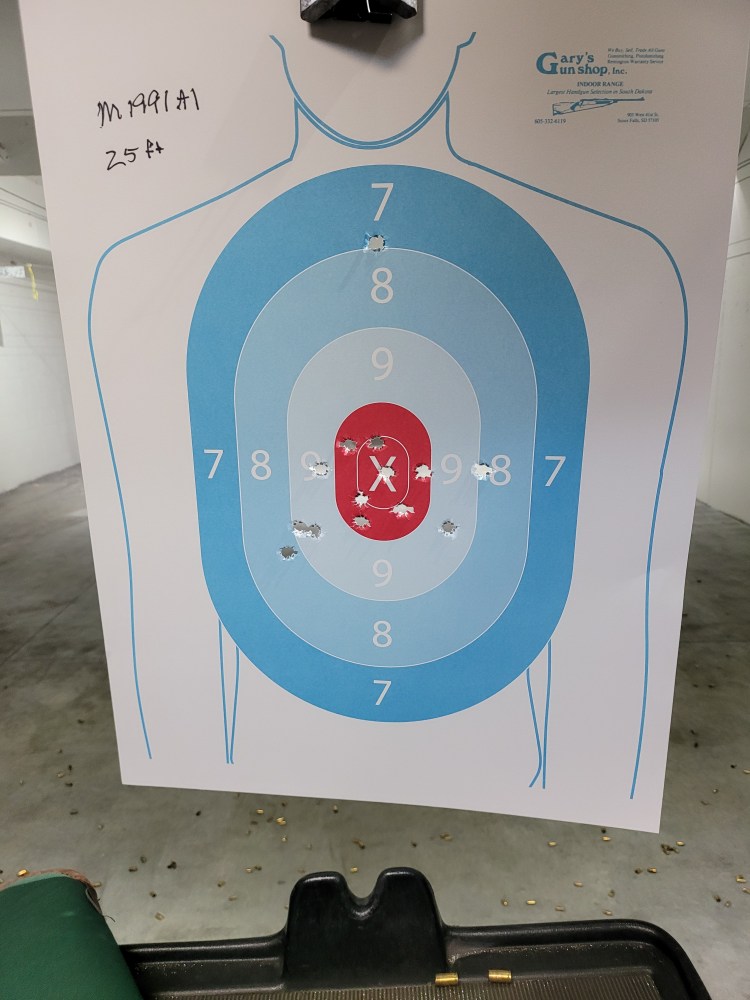
I have practiced (Bruce – Are you going to with that P word again?) enough to know just where and how to hold it to do pretty good with it . . .
and YES – Practice / Practice / Practice is the key to this . . .
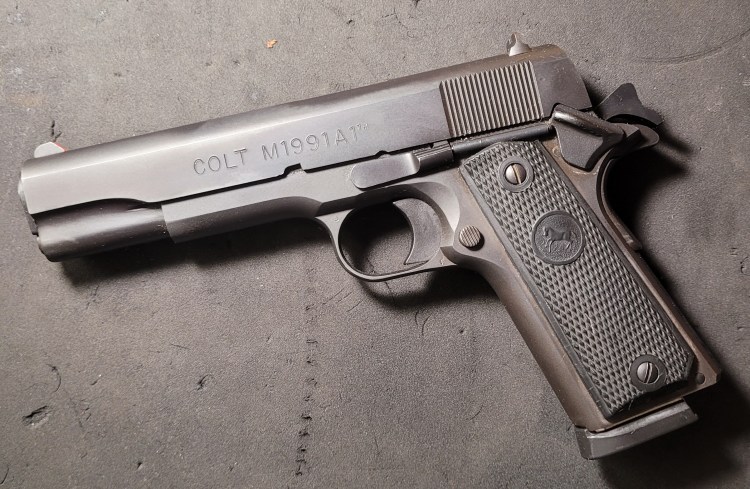
Fresh out of the bath and headed back into the holster . . .
And now onto the new kid on the block . . .
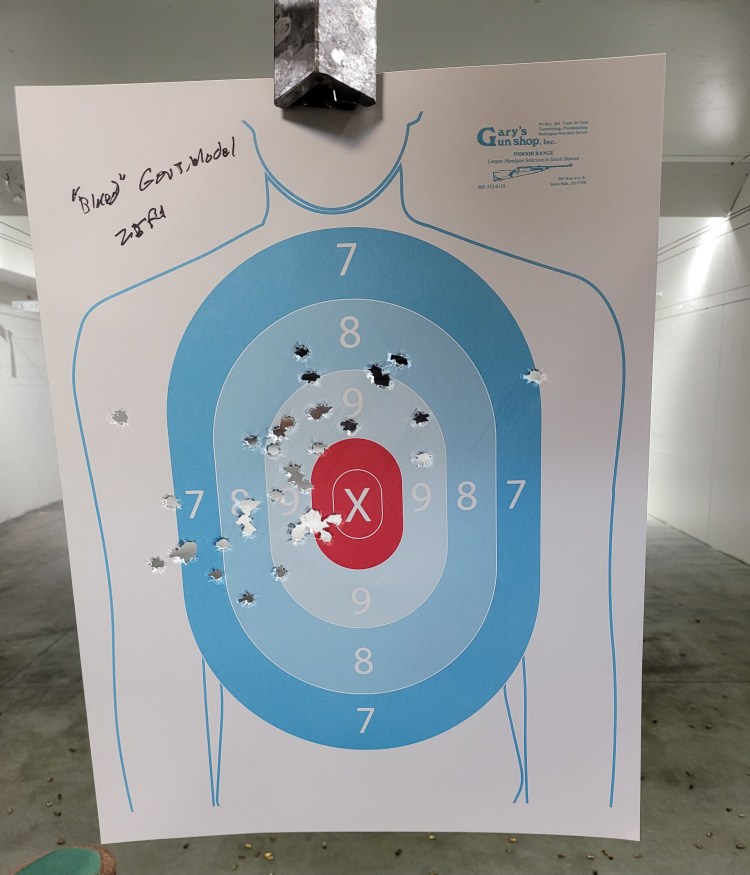
That is right at 39 rounds – more of a function check / feel thing than anything else – and yes it feels – or shoots – different than the M1991A1 . . .
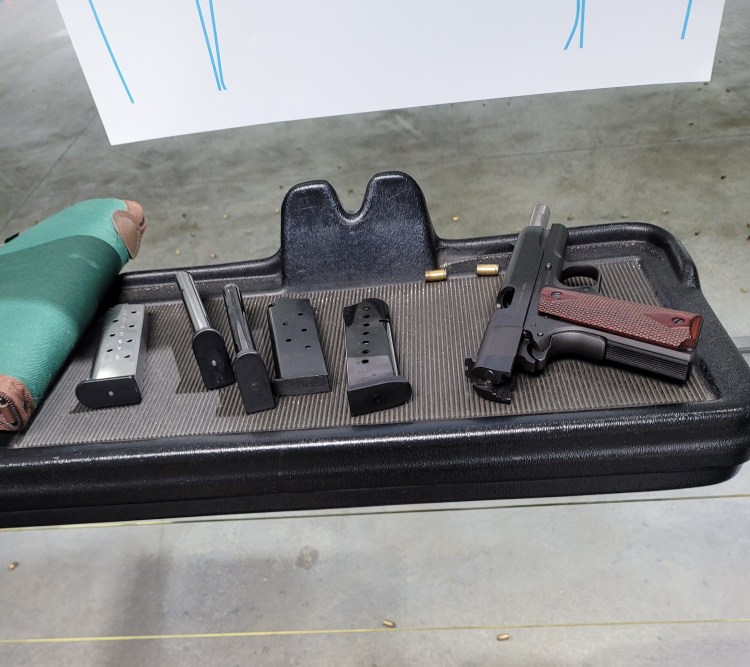
Folks, you need to realize that every gun shoots “different” – you can take two identical guns off of the shelf and they WILL shoot “differently”
That is why almost all of the folks out promoting shooting are also advocating training / practice (and if they are not – why are you listening to them??) and time and again you hear shoot the gun you carry – and keep shooting it until it is second nature to you. Basically, a reflex action. Pick “the” spot as you draw – bring it up to where it aligns – trigger press – bang – you never actually see the sights. At 25 feet everything goes into an 8-inch circle. Starting at 3 yards – Run from draw – if your range will allow you to – different strokes for different folks – or – hold a low ready grip – bring it up – sight alignment – and bang – back to low ready – wash / rinse / repeat – do that for 50 reps. When you put 80% plus in a 6-inch circle move the target back to 5 yards – another 50 reps. Now folks – it starts getting fun as you are developing muscle memory. Move the target back towards you to 3 yards and don’t rely on the sights – rely on the positioning and the look of where the gun is between you and the target. You will at some point start to realize that the “careful” use of sights slows you down. Now realize we are not going to shoot at 25 yards and not use sights – all of this is basically 25 feet and closer. You go 3 / 5 / 5 / 7 yards – then 25 feet. Plan on a couple of months and 500 to 1000 rounds – then range trips EVERY 2 to 3 weeks to stay sharp!
Just about every range either has classes available – or a list of instructors that are willing to trade their time for your money. And the majority of the time it is an equitable trade-off.
Remember folks Practice / Practice / Practice!!
let me get this posted and – how about a Saturday night movie??
Have Fun! – Run the Gun! – and remember – Fish Heads are Cheap!!
They started long before MTV – How many of you folks remember them from way back?? And I’m not talking Way Back, Indiana – LOL!
Have Fun! – Run the Gun! – and remember – Fish Heads are Cheap!!
A pawn shop score – Colt 01911C – in .45acp – I’m going to take a comparative look at this “government” model- when I did the serial number thing through Colt’s website, I found this was made the same year as the M1991A1 – I admit I was quite surprised to find it to be that old and almost zero rounds through it.
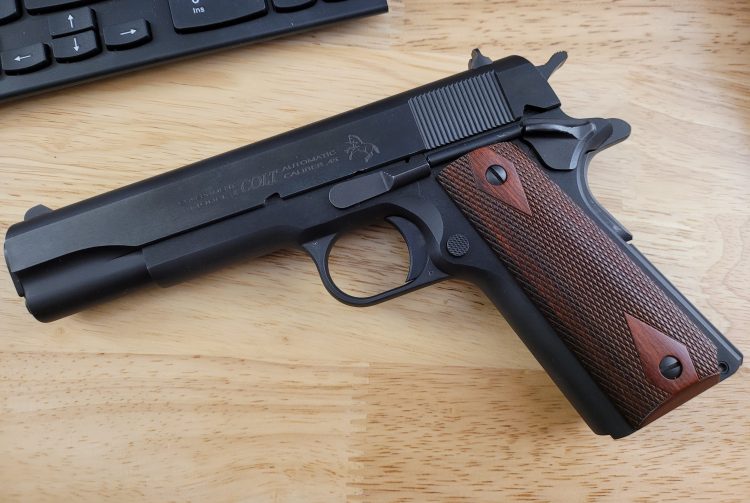
No deep scuffing anywhere – bushing to barrel – barrel hood – slide to frame – very low round count. I just can’t wrap my head around buying a firearm and not firing it. That just doesn’t fit in my head . . .
Perfect parts fitment just isn’t possible – even on high end 1911’s – “scuff” marks show up with just a few rounds – bushing to barrel – slide to frame – even with the “best practices” lubrication with enough use – finish wear spots will start showing up. Reality is a bitch!
New or used – no real difference – spray the piece down with Breakthrough Battle Born solvent – Check It Out <<<HERE>>> – thorough scrub down and then a light spray down – let it sit for a day or two – then go back and do it again – New – gets all the little kibbles and bits left over from manufacturing and gets the shipping oil cleaned out / used gets any firing gunk cleaned out of the cracks and crevices . . .
Folks – this thing is 31 years old, and I have to admit I can’t wrap my head around the lack of wear – very low round count.
as dry as the pistol was when I got it – I don’t think it was fired when new – rather just put up in a closet shelf and found during clean out for an estate sale – had a few rounds put through it and then sold . . .
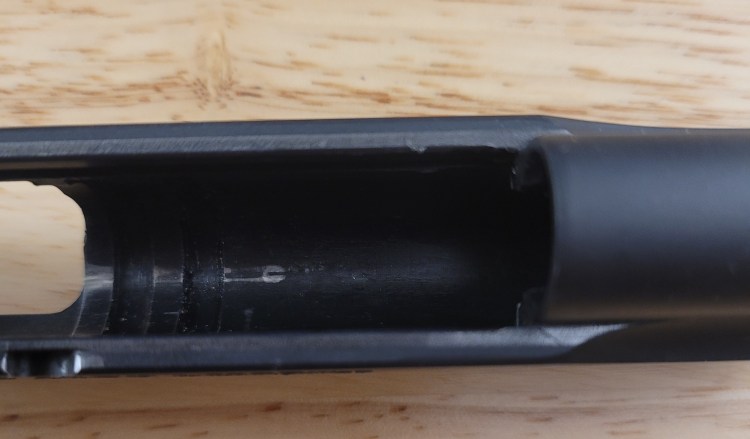
the wear you see is it – no real “high” spot wear – just light scuffing . . .

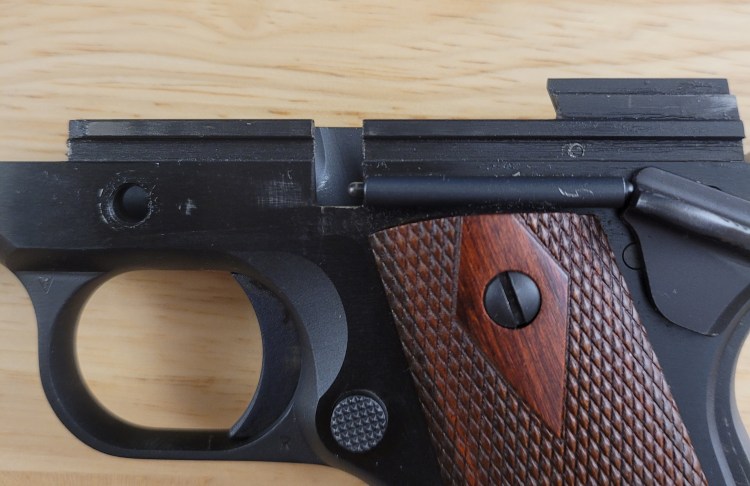
very light wear on the rails . . .
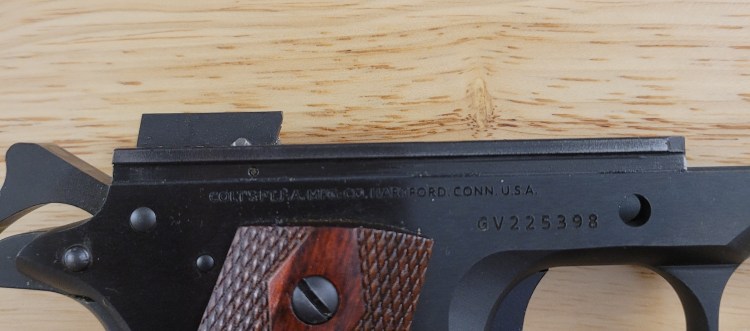
no feed ramp wear to speak of . . .
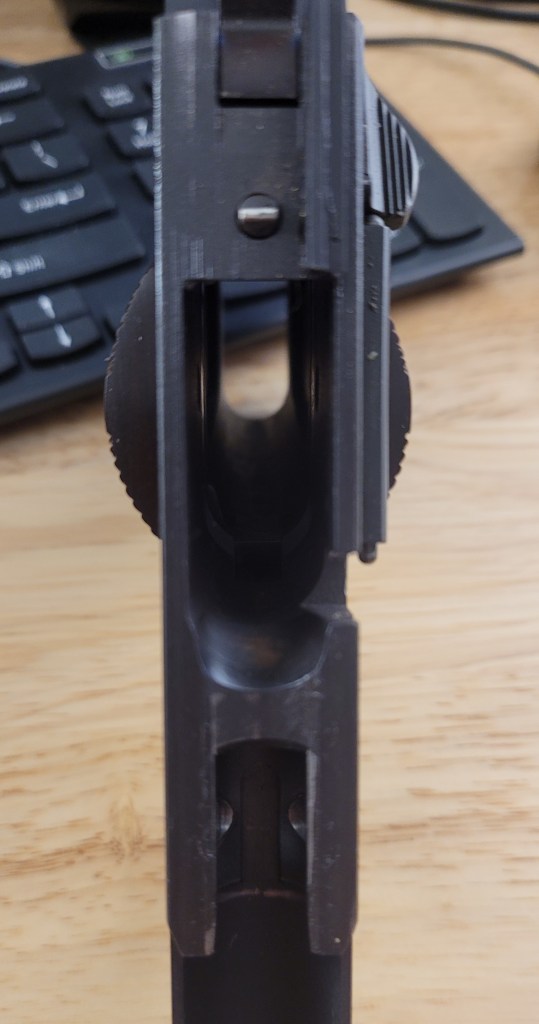
very light scuff marks on the back end of the ejector – tiny bit on the front of the rail . . .
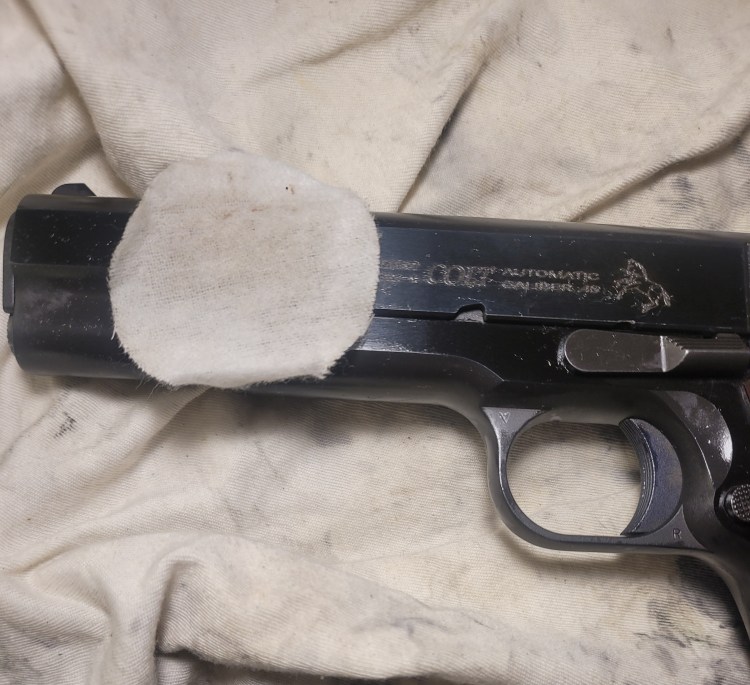
The bluing was real flat looking – So I spent the day soaking down the bluing with CLP – then wiping dry – then soaking it down again – 4 trips through that and the bluing is starting to show some depth – actually something the bluing department would claim – LOL!
just keeps “floating” dirt up out of the finish . . .
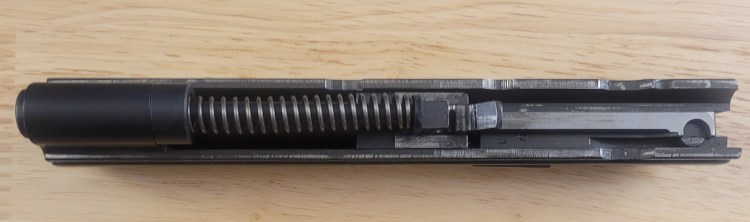
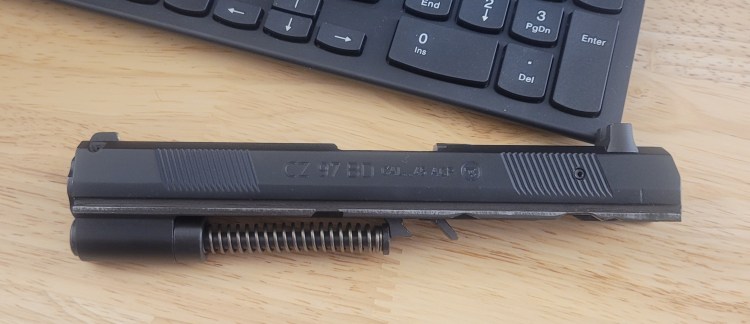
If you think of all the mating surfaces in your gun as “bearing” surfaces – similar to the main bearings of your car engine – you can start to wrap your head around what is going on inside a gun when firing. In your car engine there is NO metal-to-metal contact – everything rides on a film of oil which is refreshed by an oil pump and filtered and used again and again. A film of oil on the mating surfaces of your gun will only stay intact for a few cycles – and then your metal-to-metal. In order to mitigate that accelerated wear issue I use a thin film of Breakthrough Battle Born grease – Check it out <<<HERE>>> – the stuff will pretty much stop the wear cycle on a used gun and a new one? If the gun is built accurately and kept clean it will go hundreds of shoot/clean/lube cycles and barely show scuff marks on the wear surfaces – no metal wear to speck of – just finish wear.
Case in point: here is the slide out of my CZ 97 BD – right at 3500 rounds through it . . .
Ain’t the little darlings pretty together?
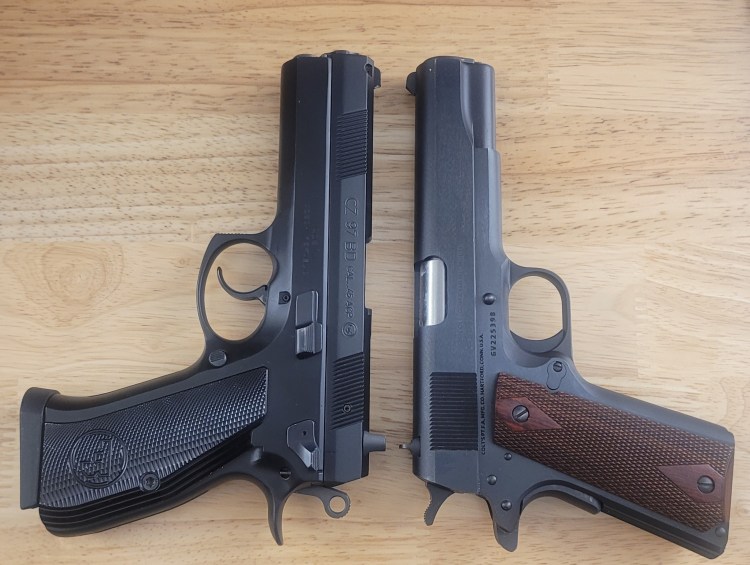
I hope to get out to Gary’s Guns and shoot the newest member (the 1911) of the family – I’ll run about 50 rounds through it – bring it home and clean / lube it.
as good as the bluing is coming out, I will probably be reluctant to stuff it in a holster and carry it – and that’s just wrong – it deserves to be carried!
And a quick shout out to Great Plains Pawn – a good assortment of stuff and very competitive prices!
Have Fun! – Run the Gun! – and remember – Fish Heads are Cheap!!
Don’t mind my rambling – it’s one of those weeks – This may actually drag out longer than I’m thinking – it might take a day or three to get it put together – from your point of view you probably won’t notice – LMAO!
So, in response to consumer pressure (yep, I was shocked as everyone else!) Colt released the M1991A1 – in 1991 obviously. Many people were wanting a new production Colt “GI” 1911 – Several U.S. manufacturers were producing them as well as the importation of different brands at that time -It was a truly “must have” item at the time – even allowing for the 80 Series firing pin block . . .
These were not inexpensive for the time – Norinco 1911’s were referred to as 2fers – 300 bucks for 2 Norinco 1911’s – a GOOD used car for 300 bucks -or 308 bucks MSRP for a Colt M1991A1 – and depending on which distributor your FFL was dealing with, the Norinco’s could be had for less by purchasing more – at the time SKS’s could be had for a little as 90 bucks a copy (and YOU clean the cosmoline off – LOL!) if you were buying 5 at a time.
Most everyone out there sorta knocks Sig for coming out with 3700 or so variants of the same gun – who do you think they learned that trick from?? If you said Colt – you’re right! Think about it – Colt only made 3 basic guns like forever – S.A.A. – Single Action Army / Double Action revolvers / and 1911’s – all of them in about a zillion variants – but the same 3 guns! The 1911 had gotten so far from what it started as – a straightforward no frills duty / combat pistol – this plain Jane was almost a breath of fresh air . . .
interesting side note: Colt started numbering them from the end of WW2 production numbers . . .
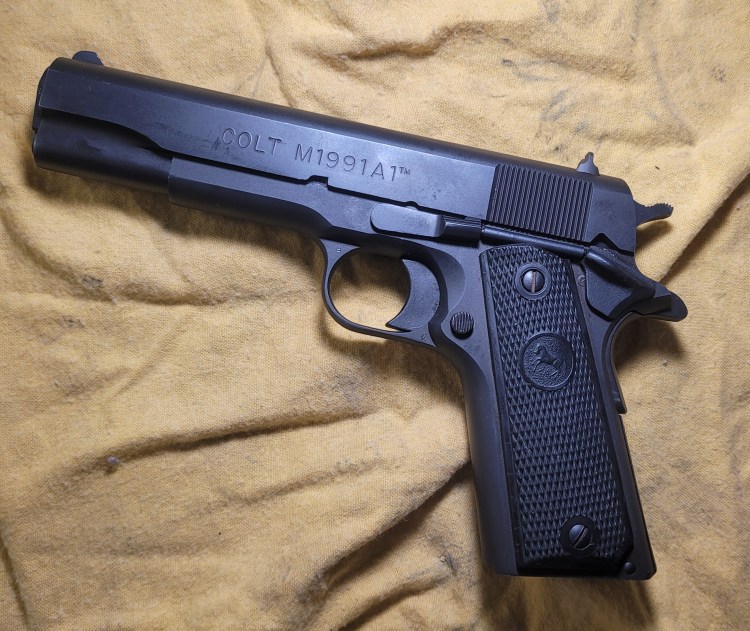
It was a brand new “government” model – as Colt envisioned one to be produced – circa 1991 – they were mucho desired by most 1911 fans – myself included. And in all honesty – for a “duty” or “combat” pistol – the firing pin block difference in the trigger pull quickly fades into the background for the majority of people – except the bullseye/target freaks. But let us not go down that rabbit hole today – OK?
The real appeal? It was not an attempt to produce yet another “upgrade” model – it was strictly a duty /combat pistol – almost a down grade model – essentially if Colt were to produce base government models again – this would be it – no high polish deep blue that you wouldn’t even think about putting in a holster – no burl wood grips – just hard rubber grips- no adjustable sights (you can drift the rear sight – that’s it) – just straight utilitarian.
A delrin/nylon straight mainspring housing – serrated – the trigger is the same material and smooth – but the serrations on the MSH and the high profile standard sights are the limit of the fancy stuff.
The finish is in black – a parkerized variant – but smooth – the lettering on the slide is a real blocky style – again nothing fancy . . .
And it shoots like a 1911 – round after round in an 8 inch circle at 25 feet – pretty much point and shoot – it will eat 230 grain ball all day – super high-tech jet fighter space force hollow points? I wouldn’t know – it was designed for hardball and I have no issue using them in any given circumstance – they simply run through the gun and make .45-inch holes in just about anything you would shoot with a handgun.
What are YOUR thoughts on this pistol? Carry with no hesitation? Too plain Jane? Something with a little more bling to it? I feel the same way about 1911 pistols (and clones) as I do about S&W revolvers – for a given piece to scratch a definitive “itch” I could talk myself into an “upgraded” variant (and I have on more than one occasion) – but – I have gotten to the point where if it ain’t gonna be used (think carried and shot regularly) – my interest drops off considerably . . .
Seriously folks – if the price point was “there” I would not mind a war production “GI” model. However the prices have gotten to the point where my nose starts bleeding just stumbling through listings on Gunbroker . . .
I know a gentleman that carries a 1911 that his great-grandfather bought new in 1925 or 6 – that’s a little beyond me . . .
Part 2 of this will be a look at the newest rescue – the Colt 0911C . . .
Have Fun! – Run the Gun! – and remember – Fish Heads are Cheap!!
A good one for you – Enjoy!
Have Fun! – Run the Gun! – and remember – Fish Heads are Cheap!!
What did you do now, Bruce? Well – I went to the pawn shop alone – my Blushing Bride was not with me – the little darling followed me home – I know! – No Adult Supervision! That’s my excuse and I’m sticking to it . . .
A Colt 01911C / Blued Finish / In God’s caliber (45acp) of course! ( I was all alone – no other Colts – just wasn’t playing well with the others )
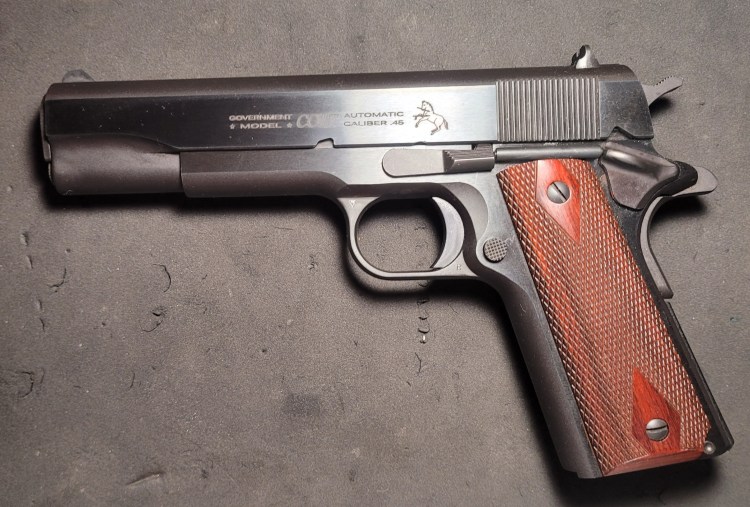
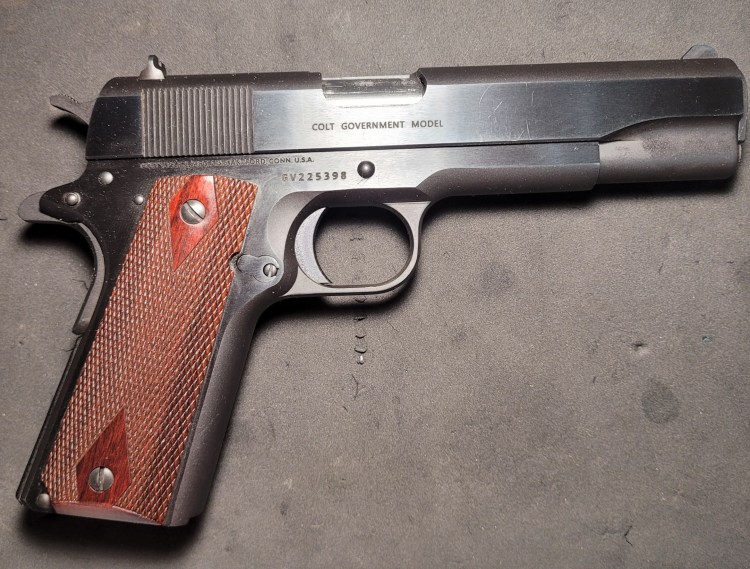
An interesting piece from Colt – it’s what they are calling a “Government Model” “Classic” series- the slide cuts are 80 series, but it has no firing pin block – so it’s a 70 series – right?
Let’s us dive headfirst in it shall we?
This is pretty much a new pistol – a few scritches – very light – on the right side of the slide (see the pics above) – no blemishes on the finish (more on that later) – no slide to frame break in scuffs – slide to frame fit really tight – if I had to guess? Less than 50 rounds through it . . .
Colt is calling this a “Classic” – it comes across with an interesting “pick and choose” blend of features . . .
In no particular order – – –
SIGHTS – Colt calls them “High Profile Standard” – they are not 3 dot – they are not “GI” sights – the Cimmaron nickel sights are “GI” pattern . . .


The front sight is obvious – higher and wider / the rear sight is taller and has a deeper and wider notch . . .
Black on black – but – much easier to pick up (see) than “GI” sights . . .
TRIGGER – It has a definite “short” trigger – short vs long being how far does the trigger comes forward into the trigger guard – the “shorter” the trigger – the easier a gloved finger goes in is the easiest way to put it . . . Damn Bruce – that don’t even sound right!
LEFT TO RIGHT – short trigger on the Colt Classic – GI trigger on the Cimmaron nickel – Current production RIA long trigger on the flat dark earth – and I have no qualms using the Cimmaron as a base for a “GI” model – they are close enough that the S.A.S.S. allows them to be used in “Wild Bunch” competition . . .

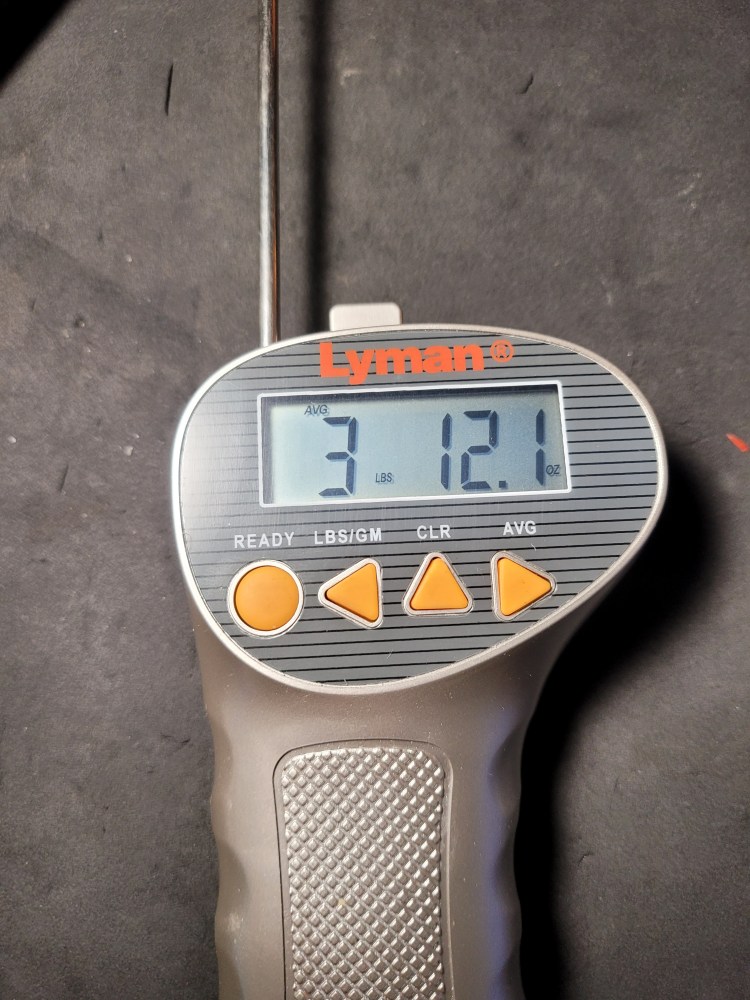
It has an aluminum serrated trigger – there is the ever so slightest creep through to the break – maybe 2 thousandths or so – you really have to be looking for it to notice it – either take it all apart and do a light polish or go to the range and put a couple hundred rounds through it to get everything and everyone happy and playing well together – the actual trigger break? Not too shabby – here’s the average for 10 pulls –
The finish is blue (?) – quite good with zero inconsistencies or blems – quite a bit of black in it to just call it blue – and it’s not just camera color saturation or your monitor color settings – it’s hard to call it “blue” when you are holding it – but blue is what Colt is calling it . . .
A few things that make you go – Say What??
70 series – 80 series – “Classic” Government Model – GI Model – or what exactly?
The barrel hood profile is 80 series – it’s about 13 thousandths narrower side to side than the “GI” barrel . . .
Disassembly notch – “GI” top vs 80 series / bottom – the 80 series makes it easier to field strip without pulling the spring plug out – you don’t have to move the slide as far to the rear . . .

The grips appear to be laminate – not slab cut – but good looking but laminate.
Main Spring Housing is serrated – originally the MSH was smooth – it’s also some type of delrin or nylon – not metal – at least it’s not arched (remember Colt is calling it a “Classic”) – for an EDC my personal preference is arched . . . see the pic of the RIA flat dark earth above
So . . . it’s not a straight up 1911 – it’s not an A1 (1917) – it’s not a 1926 civilian – it’s not a 70 series – it’s not an 80 series – BUT – it is current production that feels real good in the hand – all of that – and some other stuff – almost like a committee of schizophrenics put it together – what’s the bottom line??
Again – looks good and feels good in the hand -reminds you of a mid to late 80’s Norinco (if you ever get a chance to fondle AND shoot a good one? Just WOW – close to a religious experience) – it’s a 1911 and it’s a Colt – at this point what’s not to love – I do believe a range trip is coming up soon – LOL!
If you run up on a gently (and let me emphasize – GENTLY!) used one on the market, you can save 1/3 or more the cost of a new one – if you just must have a new one – by all means – you have my permission – no doubt worth the 1200 monies retail – it just depends on what and exactly how YOUR boat floats. Just to let you know – KYGUN.COM has them with no sights and I believe that’s also no roll marks either, not sure on that – they are listing at $849 . . . And yes, I know they are not roll marks – they are laser engraved – more cost efficient – not as much “personality” as roll marks – but progress is progress – sigh . . .
I will get a few boxes of 230 grain hardball in the next week or two and run it a little – just to see how it runs – I have every 45acp magazine I possess loaded and I’m down to my bottom limit on 45acp stash of 2000 rounds – so at this point it’s buy and shoot – just won’t go any deeper into my stash – Remember folks – It is far better to have two thousand or so rounds of a particular caliber and not need it than to suddenly have a need for a large quantity of it and only have 50 or so rounds on hand . . .
And since I’m feeling particularly generous today – one more bit of free advice – An empty magazine does you absolutely NO good!
There you go – no extra charge . . .
I’ll pick up some more 45acp and run about 200 or so rounds through the little darling – do a deep clean on it – then get you a post up with some final thoughts on it . . .
Have Fun! – Run the Gun! – and remember – Fish Heads are Cheap!!
Have a WordPress.com account? Log in now.

