Was trying to make a little less mess of my radio / junk room this morning and was pleasantly surprised to run across this . . .
I listened for about an hour and then conditions just basically went sideways – like you flipped a switch . . .
Here’s a few pics from about 20 miles North of Omaha – dark thirty Friday morning – short wave conditions have been really tough – which is why I was happy to catch Radio Turkey . . .
If you are curious you can go to Spaceweather.gov and check the site out – a whole bunch of information there – read on the site Friday that the solar flares actually raised the voltage of the rocks compromising the earth’s crust – which screws up stuff beyond radio – if you want to know more – do some research – it’s actually quite interesting – Nikola Tesla did considerable research / experimentation concerning the electrical / magnetic energy of the planet . . .
Have Fun! – Run the Gun! – and remember – Fish Heads are Cheap!!
Adding obscure lower power stations to the list is fun stuff to do – and don’t think I am knocking anybody’s station – if somebody has the wherewithal to put a station together and put a signal and program out there – That is WAY Cool!
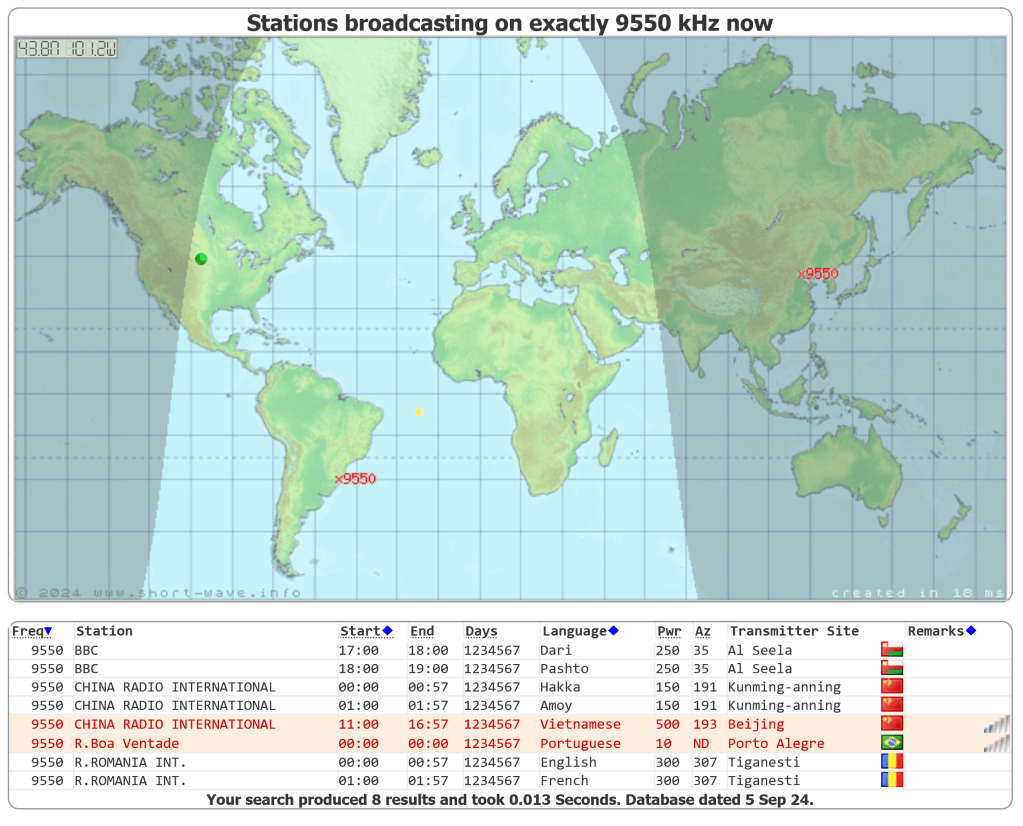
So at the same time China Radio International is pumping out 500,000 watts to the west in my direction – the green dot is my approximate location . . .
Radio Boa Ventade ( not 100% sure if this is their website ) is not quite due south of me – at 10,000 watts . . .
China Radio International – “looking” right at them with the loop . . .
“Looking” almost due South at Radio Boa Ventade with the loop . . .
Several things are at play here – The power level – 500KW vs 10KW – tremendous difference in power levels – China comes through here like a freight train – Conditions – North to South propagation is quite spotty in the daytime – Equipment – the loop antenna has 2 null spots – one to each side – but – they are not “blind” spots – still getting enough signal from China that I couldn’t prove Radio Boa Ventade is even transmitting.
I swept back and forth from 160 to 180 degrees several times – but no joy . . .
Have Fun! – Run the Gun! – and remember – Fish Heads are Cheap!!
And just to put this out here for you – and YOU as well – at this point I’m not even considering doing a YouTube short wave Listening channel thing – there are multiple channels out there that are doing really good jobs – I have enough of a backlog of just straight up reviews of “stuff” that should keep me out of trouble over the winter – and a MLA 30+ set up to do before winter – Hey, it’s an excuse to get out of town for a couple of days! – work with me on this – and come spring I have a complete random wire install AND someone who can take decent pics of all the stuff and the install – the posts I did on my install – loop & random wire – should get you through it – but the pics are not the greatest and a “stuff” list would probably help as well . . .
Not too shabby – World Adventist Radio / Madagascar – 100KW I believe . . .
If conditions are decent – they both perform well – when it’s crap conditions the loop will tend to out perform the wire most of the time because you can rotate the loop and use the nulls to “clean” signals up – the Low Noise Amplifier works great – but then you start fighting noise because you start dragging the noise floor up – at higher gain levels you’re fighting a losing battle – remember every thing is a compromise. And some of the time you can drag stuff out of the noise floor utilizing the MFJ tuner on the long wire that you just can’t “clean” up on the loop. The two really compliment each other.
The switch showed up – has anybody else noticed that if it’s something like ramen soup or a pair of socks – Amazonia has it sitting on the porch almost as quick as you click on buy – and if it’s something you really want in a hurry – it takes days??
I have a set of AM and FM filters from RTL-SDR for the feed coming in from the random wire – haven’t got them in-line yet – one crisis at a time – LOL!
The coax and fitting you see between the switch and the tuner? I finally took time to build out the correct antenna wiring set-up for the Realistic DX-160 and grounded it properly. For 50 year old tech it does well – there is a whole bunch of knob twisting going on to use it but amazingly it’s chugging right along. The eton 750 sitting on top of it shows the difference 45 years of advancement will get you. The fitting on top of the speaker? SO239 to BNC – so I can hook up the random wire to the eton 750 if I want.
Another switch or three and coax jumpers and I can move away screwing/unscrewing coax all the time – maybe set it up so I can hook-up portable radios as well – that would be cool . . .
As a side note – listening to Radio Romania International Thursday or Friday – their English language program – and the announcer was falling all over himself thanking the U.S. for the billions of dollars they (WE) had just given them to help fight the evil incarnate Putin. Anybody heard a thing about that? (I guess you use any laundry service you can ) News to me . . .
Have Fun! – Run the Gun! – and remember – Fish Heads are Cheap!!
And he is transmitting – not just receiving! For receiving? Virtually anything made of metal will do it – obviously some stuff will work better – some stuff not so good – so get out there and get to listening!
I always have one of these with me when I’m traveling – they actually work pretty good!
Have Fun! – Run the Gun! – and remember – Fish Heads are Cheap!!
Working off of my random wire antenna this morning. And it is a good morning for it – very quiet conditions.
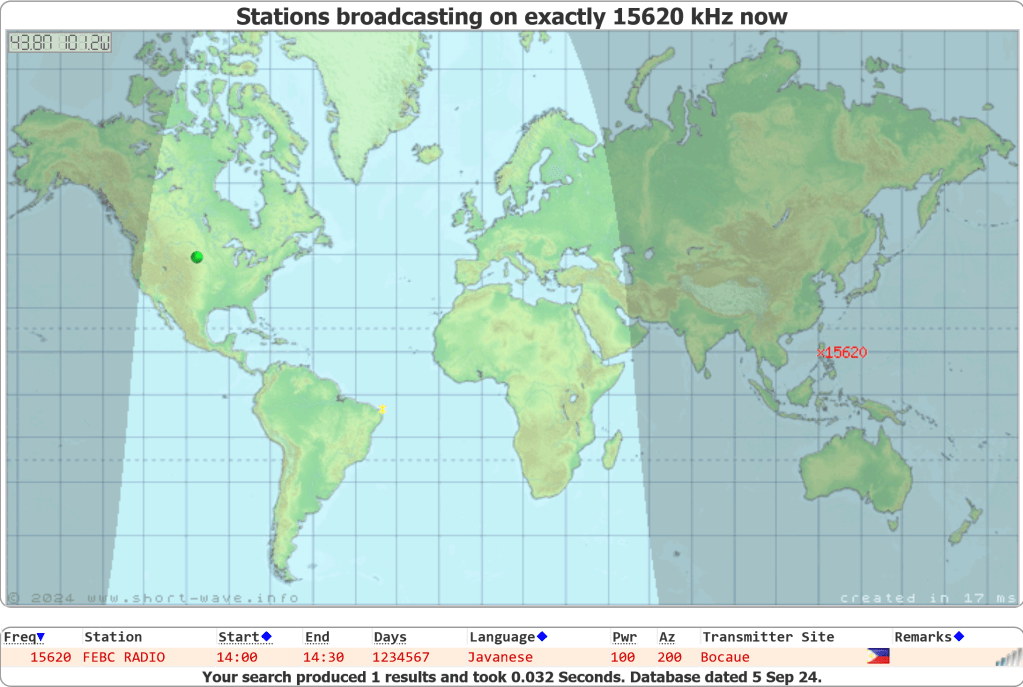
Here is what your seeing in the video – FEBC – Far East Broadcasting Company – 15620khz – pushing 100 kilowatts – not the brightest flashlight in the room – but a GOOD signal – dead on frequency with excellent modulation . . .
I can go at this explanation several ways but let’s try the K.I.S.S. way – Keep It Simple Stupid . . . ( and NO this is not a course in Radio 101 – this is just as bottom line simple as I can explain it! )
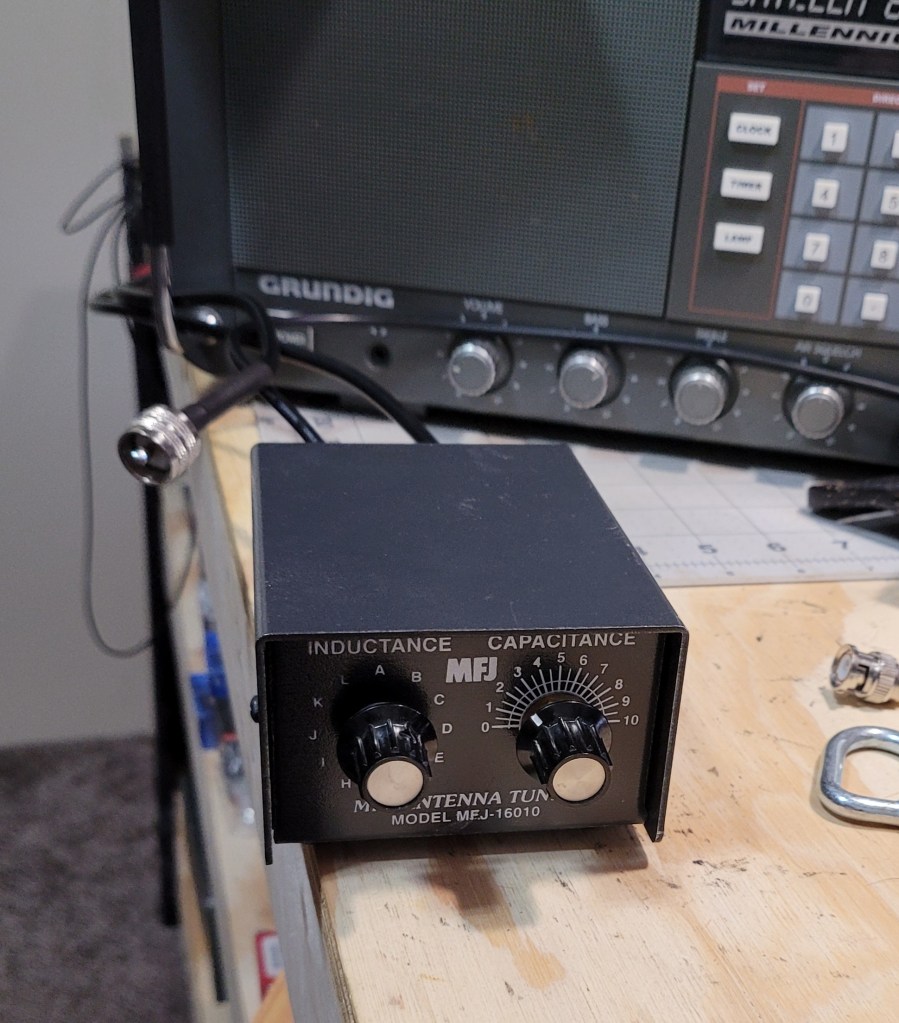
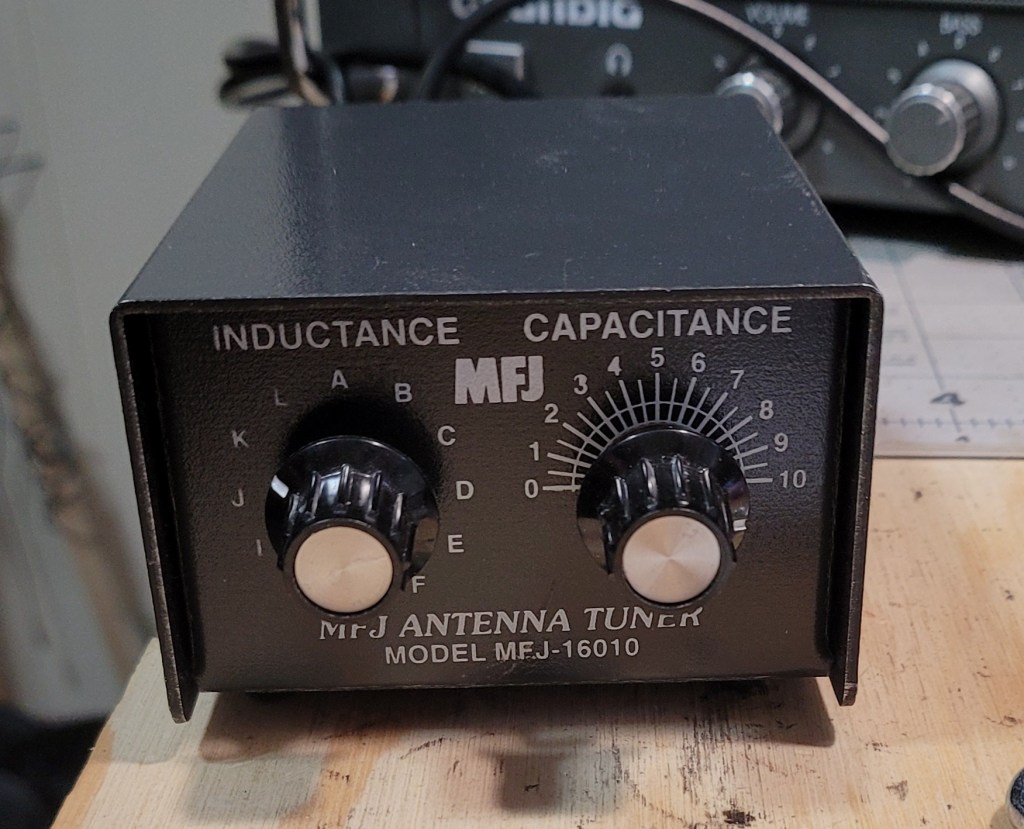
Although it was marketed as an antenna tuner for transmitting / receiving – by changing the impedance between the relative low impedance of a transmitter and the relative high impedance of a random wire antenna – guess what? It also improves that match for receiving signals as well. Because – what is radio? You hang a piece of metal out in the breeze and magnetic waves pass across it and induce an electric current in said piece of metal – meanwhile your radio is looking for a ( where ever you tuned it ) specific frequency of electrical energy to process with all its smoke and mirrors magic into sound that you can hear / listen to . . . ( yes i know that’s horribly simplistic – no hate – ok? )
Remember we are primarily focused on receiving! Watch the noise floor on the clip as I scroll back and forth on the capacitance knob – which is changing the impedance match between the radio and the antenna . . .
If you notice in the lower left corner of the clip – I have the gain on the SDR cranked all the way up – it is that quiet this morning . . .
So . . . the short answer – it does work on random wire antennas when you use it just to receive – and most of the reviews ( if you want to fall into a YouTube rabbit hole – say Hi to Alice while your there – at about 7:00 minutes into the clip ) will show it working on transmit AND receive. ( And if you want to watch the whole movie GO HERE)
I recommend stuff – because it works – and the MFJ-16010 actually helps with short wave listening when using random wire antennas – and for those who think I’m bad – a guy that is on the “net” traffic around 7.190mhz most mornings out of the Pacific North West is running on a 1200 ( yes – twelve hundred ) foot loop suspended 60 feet up in the air – I admit I’m impressed – and somewhat jealous. But really folks – it doesn’t take a lot – 30 foot – plus or minus – of 14 gauge stranded strung right – an LDG 9:1 Unun – proper grounding is critical – a halfway decent radio ( or SDR ) – the MFK-16010 in the mix can help – and you would be more than likely surprised at the stuff you can hear . . .
Have Fun! – Run the Gun! – and remember – Fish Heads are Cheap!!
Pretty decent conditions right now. If a random wire is what you want to use – go to DXEngineering and pick up the MFJ-16010 – put it inline with your coax going to your radio – assuming proper grounding – it will make a difference in what you are able to find and listen to . . . And I really wouldn’t wait too long to get one – MFJ is out of business and when they are gone – they are gone . . .
I really need to figure out how to improve my audio/video capture – there is audio in here – you can just make it out sitting here – pay attention to the noise floor between this and the next clip . . .
This is with the RF-PRO-1B loop – less noise floor and the audio is better – at least sitting here – LOL!
No settings were changed on the SDR console software . . .
This is still the loop – brought the gain up to try and match the random wire noise floor – the audio obviously came up – but – so did the noise – so you end up with a tight wire balancing act sorta thing going on – you want to have enough signal to work with – but – you are also bringing up the noise floor . . .
Bruce – where do you find all this “stuff” – weird / strange / otherwise to listen to? – One very good resource is ShortwaveSchedule.com – top of the page – right side – under live stations, click on the show me tab – most ( not everything ) of the myriad of “stuff” being broadcast live at the time is listed – and the really cool part of an SDR? You can go through the bands and see what is active at the moment – “Stuff”THAT YOU CAN POSSIBLY HEAR!
Another great resource is Short-Wave.info – you can just enter the frequency you are on and up pops the station or stations broadcasting on the frequency – with a world map complete with gray line shown – you can even put your location in so you can fidget your antenna around to maybe help with signal strength or reduce noise.
And the radio that you’re using doesn’t care what the antenna is ( to a point ) until you get down in the VLF end – then the wire antenna starts to show it’s stuff. Look at the clips again – you are looking at a little slice of the radio spectrum and there’s 15 to 20 signals there to listen to – random wire or loop or the whip antenna on the radio – so get to listening!
Folks – there is a bunch of stuff below the AM broadcast band to find and listen to – 15 KHz earth sound things / 11-59 KHz submarine digital communications. Digital but often really loud. / 60 KHz WWVB (digital time/frequency)( your fancy “Atomic” clock or watch has to have something to set itself by ) / 160-200 European Longwave AM broadcast… can be heard in most of the U.S. – sometimes / 285-325 KHZ Differential GPS / 200-529 KHz Nondirectional air beacons (NDBs) / 472-478 Experimentally licensed hams on various modes. CW, PSK others / 506-7 KHz More ham / 518 Navtex ship weather beacons / 530 Highway Info stations . . .
And for as good as it is – the RF-PRO-1B and its “loopy” cousins really drop off when you get below the AM broadcast band – as great as any given antenna is, LOOP / WIRE / BEAM – WHATEVER – they all have their bright spots and their shortcomings.
Have Fun! – Run the Gun! – and remember – Fish Heads are Cheap!!




 Guns, Fun, Food and More